
Blowtorch Diplomacy
and the lethal impact of modern day banishment
She stood on top of the oil tanker, fistfuls of gravel gripped in each hand. At her feet were two of her four children, ages ten and six. The night was dark — thick shrub and dense tropical forest seeming to close in on the tracks. Yesenia felt a wave of cramping in her lower abdomen.
The rocks in her fists were to protect her children from bandits known to rob and sometimes kidnap people riding The Beast. Tens of thousands of people take this same route through Mexico towards the United States. But Yesenia and her children weren’t traveling to the U.S.
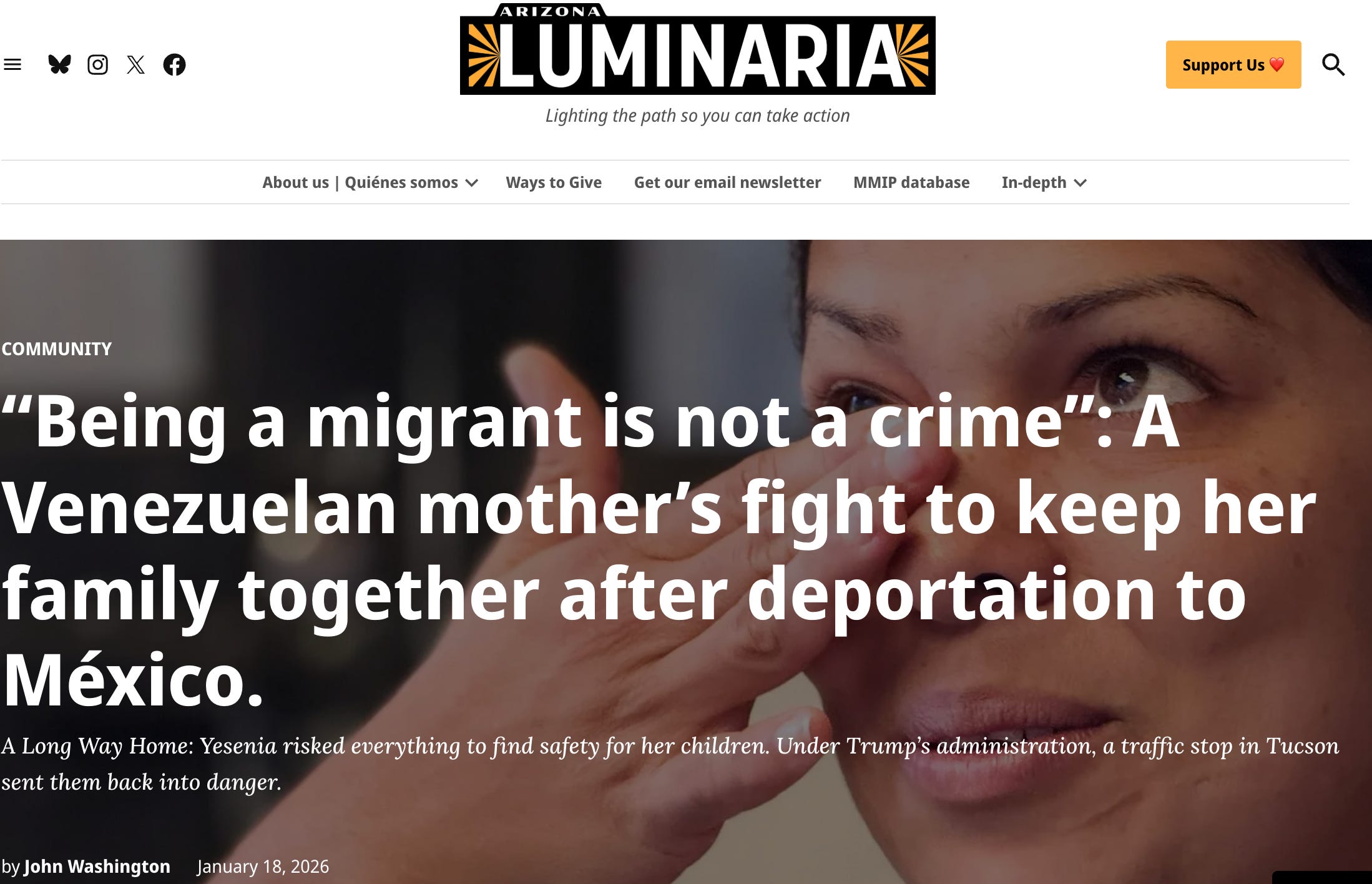
The 30-year-old mother was trying to reunite her family, after Mexican and American immigration officials cooperated in February 2025 to deport her — nearly 2,000 miles away from her husband and two other children, 7 and 14, back home in Tucson. After Yesenia was snatched and sent south with two of her kids, her husband and the other two had self-deported, and now the family was trying to meet in the middle, outside of Mexico City.
Yesenia first escaped her native Venezuela in 2018. Four years later, she fled South America altogether. Along the way, she says, immigration authorities in Mexico and the U.S. detained, humiliated, threatened, beat and lied to her. Traveling through Mexico the first time, kidnappers demanding a ransom abducted and abused her and her children. Yesenia swore that would never happen again.
Now she’s back in Mexico, fighting for their lives — again. She clutched the jagged gravel. “To defend the kids,” she said.
The mosquitos buzzed in her ears, zeroing in on the bare skin of her face and neck. Fear for her sleeping children and the drive to protect them overwhelmed the cramps, the persistent bleeding. Yesenia tried not to think about what the pain meant — the signs she was pregnant. Their first baby since she and her husband Mariano, 38, began building a life for their family in Southern Arizona.
Weeks would pass before a doctor in Mexico could examine Yesenia and deliver the news: she had miscarried.
What caused her to lose her child? Yesenia says it was the stress of her arrest and detention in Tucson, which I first reported on almost a year ago. I’ve been following Yesenia ever since. Her swift, traumatic deportation from the United States, then the exhausting, treacherous journey through Mexico, and finally the news: the binational immigration enforcement regime had caused her to lose her child.
Along with reporter Erik López of La Silla Rota, I wrote about Yesenia’s saga for Arizona Luminaria. You can read the three part series here, here, and — the most harrowing chapter — here.
The Blowhard’s Blowtorch: and the Rise of the Trump Corollary
“Massive blowtorches” — that’s what was used, or at least readied for use, in the US military’s operation to abduct Venezuelan President Nicolás Maduro earlier this month. It’s the blowtorch that perhaps best captures the current, erratic, and nearly incomprehensible, foreign policy espoused by Donald Trump.
Last November, the White House issued a new National Security Strategy in an attempt to defend and legitimize the use of the blowtorch — to access and kidnap a foreign leader. (NB: I am not here to decry, defend or assess the legitimacy of Maduro, or any of the many other foreign leaders who are doing bad, awful, immoral or deadly work at their job. I am here in the US where we have our own very serious concerns with national leadership.)
The recently released strategy articulates (kinda) what some people are calling the Trump Corollary, or the “Donroe Doctrine.”1 Those denominations are in reference to the Roosevelt Corollary (1904), which was an amendment to the Monroe Doctrine (1823).
The TLDR of those two theories of power were that the Monroe Doctrine was an early attempt by the US to basically lay out why European powers should stay the hell out of the western hemisphere and let the independence movements and nationalist shufflings of the early 19th century play out on their own. They were also, crucially, a away to exert US dominance in the region.
The Roosevelt Corollary, which came from Teddy, was a sort of a more local and proto-Bush conception (carry a “big stick”) that the US would be the hemispheric police force and debt collector. It gave greenlight to multiple US invasions, including of the Dominican Republic, Cuba, and Haiti.
Next came the so-called Good Neighbor Policy, which, in 1934, ended (temporarily) the US occupation of Haiti. “The good neighbor,” the other Roosevelt said, is “the neighbor who resolutely respects himself and, because he does so, respects the rights of others — the neighbor who respects his obligations and respects the sanctity of his agreements in and with a world of neighbors.” Neighborliness, in the US conception, has always meant political meddling, economic chicanery, and not infrequently CIA-orchestrated coups. (Nary a mention of neighborliness in the Donroe Doctrine.)
There’s a lot of history here, and I go into it at length in a forthcoming essay for New York Review of Books, but there are a couple basic takeaways: the Trump Corollary can be thought of as a return to the Big Stick Diplomacy (what I’ll call Blowtorch Diplomacy in its current guise) of Teddy Roosevelt.
Another takeaway is the importance of Venezuela itself, which is original home of both Yesenia and, among others, Simón Bolivar, whose independence fights and political maneuverings in the early 19th century were key considerations for Monroe when he laid out his doctrine. Bolívar, at the time, advocated the manumission of enslaved people and the redistribution of land to the Indigenous. He also forged Gran Colombia, a federation of multiple nations in South and Central America that was an early (and under-recognized) model of an international legal theory emulated by the League of Nations and finally the UN.
Gustavo Petro — current president of Colombia who has frequently butted heads with Trump — recently invoked Bolívar’s Gran Colombia, going as far as suggesting its reestablishment. He said it could be a “center of clean energy, knowledge, advanced technology and infrastructure for mobility and communication.”


That, as opposed to blowtorches or gunboats, is an idea worth taking seriously.
Why Venezuela?
The why of the first example of blowtorch diplomacy is complicated, and there’s a lot to unpack. I recommend Judd Legum’s take on some of the economics likely driving Trump’s hazardous interest in the country. Legum wrote how the attack may be a “a financial windfall for a prominent Trump-supporting billionaire” Paul Singer, the owner of Elliott Investment Management.
Just last November, Singer acquired Citgo, the U.S.-based subsidiary of Venezuela’s state-run oil company for $5.9 billion. Singer has also been a heavy backer of Trump, donating millions to Trump’s Super PAC and to his transition.
Citgo owns three major refineries on the US Gulf Coast, 43 oil terminals, and a network of over 4,000 independently owned gas stations — all well positioned infrastructure to potentially benefit from processed Venezuelan crude. Though Exxon sees Venezuela as “uninvestable,” Trump — and certainly Singer — sees it otherwise.2
Besides oil, or a wag the dog moment to shift attention from Epstein, migration is another huge factor in the invasion. In recent years, more people have fled Venezuela than any other country in the world. Over the last five years, half a million of those fleeing Venezuelans, including Yesenia, came to the US. (Many, many more went to Colombia and other Latin American countries.) The Trump administration has repeatedly used those migrants as a useful bogeyman. This is the war on terror turning inward, an example of what Nikhil Pal Singh calls in The Equator, “Homeland Empire.”
The invasion may turn out to be a windfall for oil barons, a protracted cataclysm, or something else entirely — with Cuba, Mexico, maybe Colombia in Trump’s crosshairs, it’s worth watching closely how the Trump Corollary — and Blowtorch Diplomacy — are put in practice.
And what happens if (when?) the blowtorch is turned against the icefields of Greenland?
Book update
I am hours — hours — away from deadline.
More on that soon.
Read and subscribe to Jordana Timerman’s excellent substack of Latin American news and analysis.
Exxon CEO Darren Woods recently made an implicit reference to the Good Neighbor Policy: In saying conditions for extraction have to be a win-win-win — wins for the company, for the government, and for the people — he said, “We have to be wanted there — and to be a good neighbor.” (Woods made no mention of wins for the environment: because there are none.)
Thanks John, we'll be watching...