
Immigration "extremism"
and facing down the pepperballs
Last Friday morning, Dec 5, I started catching pings on a couple of the ICE Watch Signal channels I’ve been invited into as a reporter: federal immigration agents were supposedly in my neighborhood. I wasn’t home at the time, but once I saw the Signal dings turn into a syncopated beat of notifications, I hopped on my bike and headed over to Taco Giro, a shop just a few minutes from my house.
When I arrived, about thirty or so community members were on the sidewalk right in front. Roughly the same number of agents with HSI (Homeland Security Investigations, a division of ICE) were inside the parking lot. They were dressed to the martial nines: overfilled flak jackets, gaiter-masks, hip-holsters, big watches, wraparound sunglasses. A couple of them had AR-15s strapped to their chests.
Agents lugged about ten cardboard boxes filled with documents out of the restaurant, at least one computer, and loaded them into their cars. I didn’t see — and nobody I spoke to saw — if they had arrested any workers (part of the building was out of view). Later reporting revealed that at least 46 people were arrested in the region.
The people on the sidewalk chanted, sang, demanded answers and info. The agent in charge I spoke with wouldn’t give his name or rank, or say anything except that they were serving a federal warrant. He frequently held up his phone, recording us back, taking pictures or maybe video of the press and other folks outside.
More community members started showing up, cycling through chants. People mocked the agents; some of them tersely answered back. And then came the officers in helmets, and you could feel the tension rise. The first flash bang went off.
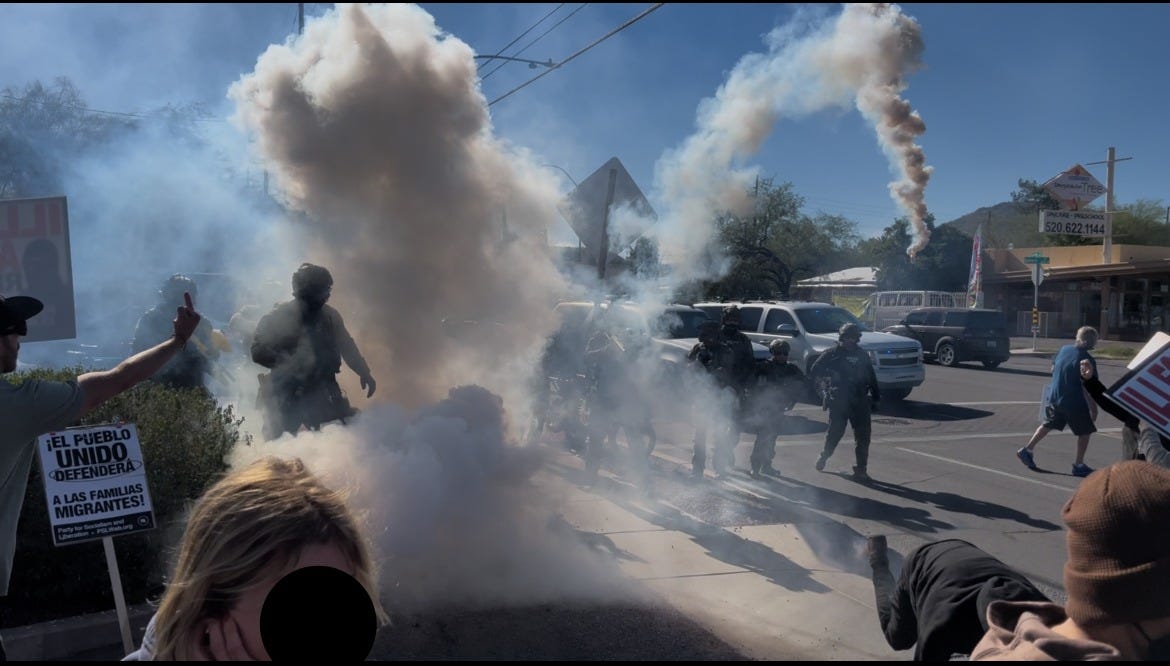
The building in upper right corner, with the diamond-shaped sign hanging from a post is a pre-school. One of my close friend’s child used to attend there — it’s a sweet little school. Agents outside shot pepper balls, shoved people, violently tackled others, deliberately pepper-sprayed folks in the face.
When Adelita Grijalva, the newly seated Congressional representative, showed up (I covered her election closely for Arizona Luminaria) she got right into the mix, telling officers to calm down, trying to stop an arrest, and asking for information. She also got pepper-sprayed.
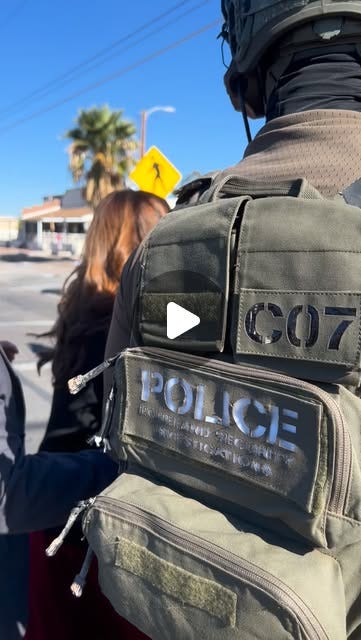
You can see the moment Grijalva got hit with the spray right here (wait for the zoom-in):
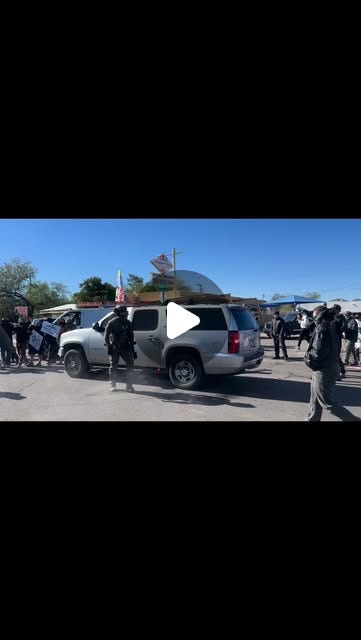
In the melee, the dozen or so HSI vehicles tore out of the parking lot and drove away. At least two community members were arrested. One of my friends, Tucson Sentinel reporter and photographer Paul Ingram, was pepper-sprayed almost point-blank in the face. I don’t know how many others were injured. I got sprayed as well, not directly, but spritzed enough that it stung, and a spicy cough lingered for hours.
A little while later, community members gathered at one of ICE’s Tucson field offices. ICE officers stormed them there as well, allegedly pepper-spraying people through a fence.
Just days before that, I spent an early morning with a 28-year-old Colombian woman and mother of four who turned herself, along with her kids, in for a self-deportation. She told me she had been living in an extended state of panic after her husband was arrested and deported a few months back. ICE agents came multiple times to her family’s trailer, banging on the door, trying to arrest her as well. She and her husband and two of her kids were asylum seekers. Two of the kids were U.S. citizens.
“Extremism”?
A couple months earlier, on September 25, in the wake of Charlie Kirk’s murder, Trump issued a presidential memo targeting anti-fascist and other such supposedly domestic terrorist organizations, laying the groundwork for targeting, among other groups, people who support migrants. Then, on December 4, Attorney General Pam Bondi issued her own memo outlining the tactical implementation, explaining how federal law enforcement agents can target so-called “domestic-terrorism.”
“Particularly dangerous,” according to the Bondi memo, are groups motivated by “political and social agendas, including opposition to law and immigration enforcement; extreme views in favor of mass migration and open borders; adherence to radical gender ideology, anti-Americanism, anti-capitalism, or anti-Christianity; support for the overthrow of the United States Government; hostility towards traditional views on family, religion, and morality; and an elevation of violence to achieve policy outcomes, such as political assassinations.” (Emphasis mine.)
FWIW, my last book was titled The Case for Open Borders.
FWIW, it’s not a crime to be anti-capitalist, or to adhere to any of the views or ideologies listed above, including anti-Americanism.
Here’s the Bondi memo in full:

Homage to a bookstore
I bought Beckett in that bookstore. I bought Racine. Nabokov’s Speak Memory. I picked up this weird and kinda wonderful book about time (Time Blind: Problems in Perceiving Other Temporalities, by Kevin K. Birth) which for some reason has sat on my desk for nearly two years. Tree of Smoke. Lorca. A few dozen other books on my shelves all hail from the same shop.
I didn’t know the owners’ names but we recognized each other, or I think we did. I recognized them. We engaged in small talk and literary flummery. I didn’t go there a ton, but when I had the time I browsed there.
The Tucson bookstore is called The Book Stop, and when I caught on social media a couple weeks ago that it was closing at the end of the year, I felt — and the feeling surprised me — crushed. Tucson, and probably every town, needs a bookstore like that. Its closure was one extra piece of bad news I didn’t have room for. Not to get too personal, but these days my cup has been spillething.
I browse in bookstores in a way I browse nowhere else. The word browse is etymologically related to breast: to sprout or shoot. You nibble at books in a store like like animals nibble on plant shoots. Where else can you taste so much, so healthily, in such abundance and for free? (Libraries is the obvious answer. They’re also wonderful in their own way, but most American libraries I know are too organized and uniform — without with the flavor or must of a good bookstore.)
I think the reason the news hit so hard is that I’ve been thinking a lot about a certain segment of society: the neighborhood. About what its construction and cohesion means, as a building block, for greater society.
I’m almost done with my current book, How to Close a Camp, an investigation about how communities have pushed back at immigration extremism, particularly immigration detention. I don’t know what to call the shape we’re in, as a society, when the president calls people from one nation “garbage.” Such words can and do turn into bodily injury and death. It’s how traumas — and much worse — begins. Reversing course, I believe, starts at the neighborhood.
I don’t know how best to respond to any of the above, but I’m trying to do it with the coming book, this newsletter, reporting, and my neighborhood — knowing, caring for, and relying on my neighbors.
The good news (emphasis again mine — whose else would it be?) and I’m so glad to end this missive with it, is that I called The Book Stop recently to potentially do an article about them closing. They told me they have a couple buyers lining up. For now, they think the store will remain open.
Proud of Tucson media and Congresswoman Grijalva for holding their ground and holding ICE accountable. The Trumpstapo are really out of hand.
Thank you for your eye witness and presence. I’m feeling with my AZ peeps today, reading a statement from board chair of UUSJ about moral injury vs. PTSD. We cope with both in our work for democracy and plain humanity.
Barb Lemmon, GV Sams.