
How to Close a Camp
My book is out — in seven days. Here's where you can catch it
“Always alive has been the resistance.”
I stoop to quote myself, from my newest book, How to Close a Camp, which launches July 21.
This was and is a different kind of book for me: a rapid response to a rapidly changing, deeply troubling, and increasingly violent expansion of immigration enforcement. Coming at you now.
A bit about the book’s origins…
My editor at Haymarket, the great Katy O’Donnell, approached me last summer and asked if I’d consider writing a “quick book” on the changing immigration landscape. We chatted a bit, I thought about it for a couple weeks, and then said yes. A few weeks after that, by late August, I got cracking: every early morning and every night for the next 130 or so days, with just a few exceptions, I steeped myself in the history and contemporaneous horrors of the immigration detention system, something in which — to mix culinary metaphors — I’d long been baking myself. I did dozens of interviews, read as many books and reports as I could cram in, and nearly calloused my fingertips clacking away at the keyboard. In the end, the book will have gone from initial concept to hitting the shelves in a little under a year. That rapidity — “crashing” the book, in the trade lingo — was only possible due to a dedicated crew of editors, copyeditors, sellers, publicists, and designers.
I also leaned into community: I worked with a handful of great researchers, sound-boarders, and preliminary editors. And, of course, the book is based on the ideas, work, and spirit of the many individuals and community groups I profile.
The work also took its toll, costing me my eyesight and my job.
Last January, about a week before I had to turn in the manuscript I woke up and couldn’t read the weather report on my phone: my vision had fuzzed. Washing out my eyeballs in the sink and a stiff coffee didn’t help. That same morning, so I wouldn’t miss a day, I went to the pharmacy and bought reading glasses — I’m wearing them (actually slightly less dorky versions of) as I write this line. And as for the job: long story, but, basically, a couple months into drafting, editors at my last gig thought the book was too “partisan” and made me decide between writing the book or writing for them. It felt like getting knee-capped mid-race. And suddenly, on top of my already overspilled days, I had to find time for job searching. I barely slept last December.
But my petty personal costs were nothing compared to the emotional havoc, physical suffering, and death wrought by the immigration enforcement regime. And those hazards, and how to respond to them in a productive way, are what this book is about.
I focus on immigration detention for a couple reasons, one of them recently articulated by a former immigration official. Speaking to the New York Times about the flailing warehouse detention approach, the official said, “The warehouses were a quick concept to scale up mass deportation.” He continued: “Immigration detention is necessary for a successful deportation plan, and this was the easiest point for the Democrats to attack and stop that effort.”
And it may be the “easiest” point, but blocking a new camp from opening ain’t easy. Even harder is closing an already operating camp.
The immigration camp is the linchpin of the system: mass arrests and mass deportation simply can’t function without the camp. And the camp itself, both symbolically and in practice, uniquely captures the logic of immigration enforcement. As I show in the book, the camp and the wall — as well as earlier iterations of each — have been the core tools of colonialist efforts to divide, immobilize, and deport for over 500 years. This book, and my last — The Case for Open Borders — are about knocking both of them down.
I get into all of this history and theory, focusing on what immigration activists have modeled to end the camp system, in the book. And I hope you give it a read.
Buy or borrow a book for yourself, your neighbor, your mother. Scroll down to the Resources section of the book’s page for a handy list of organizations to plug into or support, as well as know your rights info and how to dissect a camp, all of which is included in the book’s appendices.
Buying books, by the way, is what makes writing books possible. So please support your independent publisher and your independent writers.
Below is a short excerpt, and here is a list of cities and events where you can catch me in discussion with some of the best thinkers and practitioners on the subject.
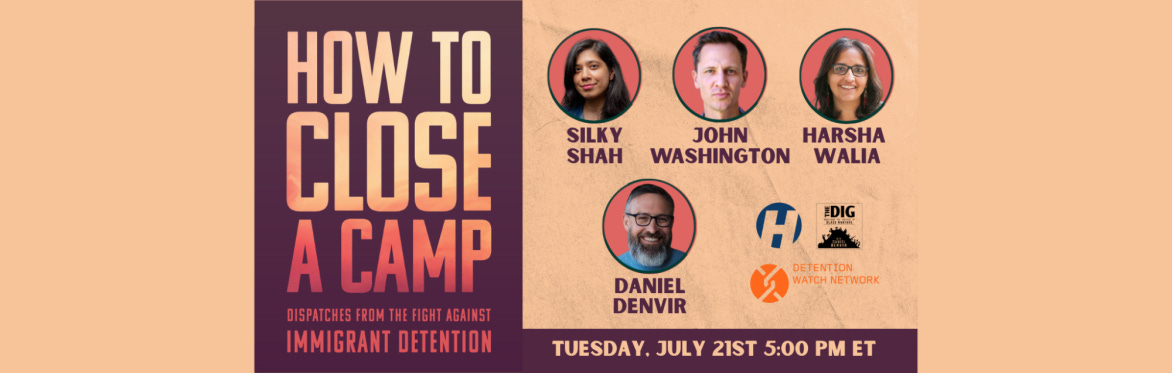
I start online, with the Haymarket virtual launch, in conversation with Harsha Walia and Silky Shah, and with Dan Denvir moderating.
My list through September.
(I’ll also be on the east coast in November, and will offer dates soon.)

An excerpt, on efforts to close the camp, from the end of the Introduction:
Always alive has been the resistance. For as long as the camp and its attending massacres and ethnic cleansings have been wielded, they have been met with rejection. People have pushed back: walked away, cried foul—refused to be contained.
Across half a millennium, the struggle has never only been about land—who has the right to claim, control, protect, live on, or exploit it—but also about movement: the right to remain and the right to leave. After all, the first instinct of conquest is to dictate movement—forcing some to scatter, others to stay penned in. A detention cage and the threat of deportation is the most absolute form of controlling motion, the distillation of colonizing logic. The body is fixed, the horizon narrowed, and the possibility of movement foreclosed.
Yet even in the darkest hours, lines have been walked, rivers crossed, boundaries not militarized but celebrated. Historian and ethnobotanist Gary Paul Nabhan, in Against the American Grain: A Borderlands History of Resistance, writes of the Yaqui resistance to the first Spanish colonizers’ incursions into their native lands in modern-day Arizona and Sonora: to safeguard their territory, Yaqui elders and warriors took the approach of “singing the boundary” of their homelands. They stood guard, shot poisoned arrows, danced, and repelled an invading army of slavers. They pushed back and kept the Spanish away for over seventy years, and they have never ceded their territory. Against the machinery of confinement, there persists the slow, stubborn knowledge that both movement and life itself are freedom, and that to protect them—whether with sail or song—is to resist the walls closing in.
In contemporary philosopher Thomas Nail’s Theory of the Border, the border is not a line but a machine—an ever-moving apparatus that sorts, slows, and accelerates bodies according to the needs of power. The walls are not simply built and then left to stand; they churn, adapt, and extend their reach deep into the interior of a nation and far beyond the frontier. The camp is one of the wall’s purest expressions, a place where motion is not just halted but transformed into a slow attrition of life. To resist such a machine requires more than opposition at its edge; it demands a reimagining of movement itself as a collective, shared right—one that neither the state nor the border can legitimately grant or deny. In this sense, every march, caravan, legal fight, online campaign, or pot-and-pan rally is not only an act of refusal but a reclaiming of the world as a space meant to be shared and traversed.
and highlighting one particular event because I so love my home, Tucson:

eyes always get fuzziest before the dawn, or so the saying (sort of) goes. wear those glasses with pride. 🤍
Wonderful, John.
Gotta come onto my radio show once again.
I have Mr. Fish on, interviewing him Thursday and broadcasting his talk with me in August.
kyaq.org
Unfortunately, Eichmann and Faust and that old saw are on steroids:
Upton Sinclair — 'It is difficult to get a man to understand something, when his salary depends on his not understanding it.'
Coming September:
400+ senior leaders from CBP, ICE, DHS, DoD, USCG, state and local law enforcement, and international partners to address the evolving challenges shaping border security operations today
It is absolutely disgusting how militarized this society is, up and down.
https://paulokirk.substack.com/p/400-senior-leaders-from-cbp-ice-dhs
Remember?
'From the Rio Grande to Washington DC, all undocumented immigrants shall be free!'
https://paulokirk.substack.com/p/from-the-rio-grande-to-washington?utm_source=publication-search