
European Hordes
let's be honest about the dangers coming from "this" side of the border
A lot of ink, a lot of handwringing, about a border breach into “Spain.”
You surely saw the headlines, probably caught a video snippet or two of hundreds of men running up a beach, swimming around a fence, hunkered in a plaza. Over 50,000 Moroccans (and a few from elsewhere in Africa) recently crossed a guarded border and entered into a small curling tail of a peninsula in Northern Africa known as Ceuta, or Sebtah according to Moroccans, which is territory claimed and controlled by Spain. And then: Europe lost its shit.
Though lip-servicing human decency, Spanish Prime Minister Pedro Sánchez responded by sending in the troops and the tanks. European Commission President Ursula von der Leyen leaped to conclude, “It is clear that we must do more to further strengthen our borders at critical points, both with vigilant monitoring and the use of physical barriers where needed.” Italian PM Giorgia Meloni said her country was ready to take “extraordinary measures to defend our borders and ensure citizens’ safety.”
Such proffered measures included the suspension of the Schengen agreement: for Spain to be booted from the free-travel zone, the 29-European countries across which people can travel relatively freely.
Trump, meanwhile, said of the border breach: “I watched the catastrophe that took place. It looks like an invasion of a country by hundreds of thousands of people. And that same thing is going to happen to us if the Republicans don't get elected.”
Despite the alarm, von der Leyen was happy enough, noting: “Not a single person reached mainland Spain or the rest of the EU.”
But 70 people died in the confusion, and the paradox of Ceuta persists. The President of Spain’s right wing Vox party called for the small territory’s “permanent militarization.”
A key distinction between migration and invasion: migrants are people who move to a new place (for various reasons, typically some combination of safety needs, freedom, work, or family) and assimilate into the new society; invaders are people who go to a new country to conquer and despoil, not taking on, but taking over a culture or a society.
A bit of background.
Why is this spit of land, Ceuta or Sebtah Spanish? Basically, because Spain wanted a coaling station.
Around a thousand years ago, Ceuta was a launching station for the Muslim occupation of the Iberian peninsula. Then, during the Reconquista, first Portugal, and then Spain, took over parts of Northern Africa, including Ceuta. For the next five hundred years it was contested territory, but mostly controlled by Spain. And then, during the 20th century European land-grab — the so-called Scramble for Africa — Spain and France deemed much of what is today Morocco a protectorate, with Morocco not gaining independence until 1956. But Spain kept its grip on Ceuta and another bit of land, Melilla, also on the Moroccan coast, for strategic military and financial purposes. They thought it would make a good coaling station.
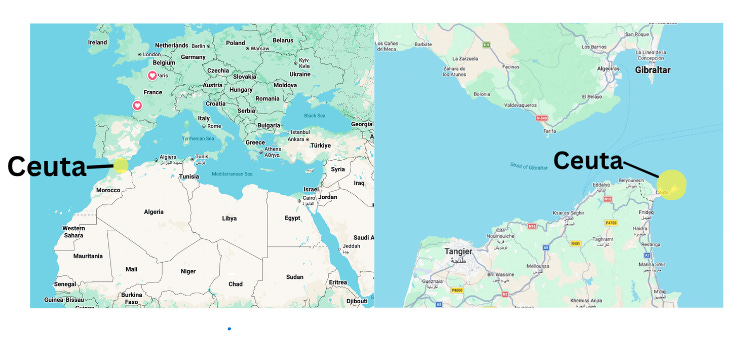
The territorial disintegrity exposes the warped logic of bordering. That Ceuta and Melilla belong to Spain make zero geographic sense. And that senselessness is reflected in the weird status both cities maintain.
I recently talked to The Border Chronicle about the very few countries left that impose exit visas, which is a requirement to get a visa to leave one’s own country. My mother needed one to flee Romania as a teenager. That was when it was still a satellite state of the Soviet Union. Very few exit visa regimes exist today: North Korea, Turkmenistan, and… kinda, Spain.
Because Spain is both part of the EU and party to the Schengen agreement, as well as attached to Africa, anybody leaving Ceuta for mainland Spain needs to get a pass from the National Police before crossing the Strait of Gibraltar.
That is, Spain wants it both ways: they want the territory, but not the people: a near perfect embodiment of colonialist logic.
Since the recent border breach, the media has mostly fallen into two categories: fear-mongering about what a moment of mass movement portends, and attempting to allay those fears by reminding those in a tizzy that almost all of the migrants have already been sent back to Morocco.
But dozens died in the effort. That’s a tragedy, and one that won’t be resolved or avoided by the hastily installed border buoys, which will likely just make any future attempts at cross-border movement even more deadly.
Few have taken the time to look at the bigger picture. About 118 million people around the globe are forcibly displaced from their homes. That doesn’t count the many tens of millions more who are precariously stranded between the twin rocks of persecution (whether political, economic, or climactic) and border regimes.
That’s to say, what happened recently in Ceuta was not a one-off. And while Moroccan authorities likely used desperate would-be migrants to take a political jab at Spain, the reality is that many millions more need little prompting to hazard attempts at a better life. We’ve seen this on these two specific exclaves before.
In 2022, 23 people were killed as about 2,000 people, mostly from sub-Saharan Africa, attempted to cross into Melilla from Morocco. In 2014, at least 14 people died near Ceuta when 200 people tried to climb the border fence.
Meanwhile, thousands of people attempt to cross the Mediterranean every year from north African countries and Türkiye. Since 2014, according to the International Organization for Migration, over 35,000 migrant deaths and disappearances have been recorded in the Mediterranean, making it the deadliest migration route in the world.
And though Spain was desperate to push all the 50,000 people back across the border, some credit needs to be given to Sánchez’s administration. Recent legislation acknowledged “the reality of nearly half a million people who already form part of our everyday lives,” with Spain approving an amnesty measure. That figure, however, is less than half of all the undocumented population of Spain, the rest of whom will remain undocumented.
At the same time, Spain holds on to these violently imposed outgrowths of territory: Sánchez said that the mass movement composed an “attack on Spain’s territorial integrity.” Dubious word choice — integrity — given the history of Ceuta, and the obvious non-contiguous nature of its land claim.
Meanwhile, Europe is setting the stage for ICE-inspired crackdowns throughout the continent. The EU’s recently approved Return Regulation allows for a host of new draconian measures, including increased immigration enforcement, extended detention, and a massive expansion of third-country removals (shipping people out to countries they’re not even from).
All of it amounts to a hateful nest of xenophobia and racism. Even the liberal moderates in power, such as Sánchez, trip into the deadly logic of border crackdowns.
In my last book, The Case for Open Borders, I wrote a lot about the deceptive fear-mongering of what moments of mass migration look like. And while I argue in that book for what the title obviously implies — open the damn borders — an ultimate solution is a lot more complicated than allowing free migration.
Open borders is best thought of not in simple terms of “opening the gates” but as a massive infrastructure project, a foreign policy reset, and reparations. As long as Spain holds on to Ceuta and Melilla, as long as the global north engages in extraction and environmentally/economically destructive policies, at the same time they try to seal their borders, we will continue to witness, or directly experience, tragedies along our borderlines.
Sánchez could have used the moment to push for broader conversation about forced displacement and long-term stability and freedom. Instead, he scrambled to pacify the likes of von der Leyen and Meloni.
Reading
Now that my book is done and out, I’ve taken to enjoying fiction and poetry that is not about immigration horrors, and it’s been fantastic. Here are a few recent gems:
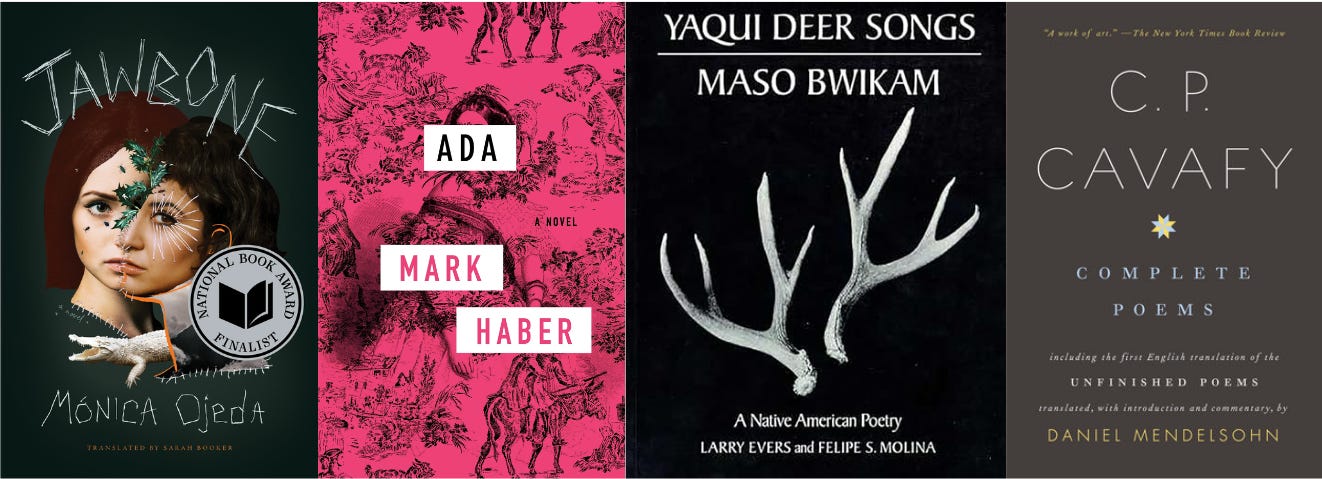
In light of the popular and decidedly decent recent film, The Odyssey, I’ll leave you with what I consider a blessing from C.P. Cavafy.
From his beautiful poem, “Ithaca”:
Hope that the road is a long one.
And you know what kind of road Odysseus travels. And I so hope.
Full of compassion, insight, history lesson and very timely